
Take 95% of the work off Claude: our T3 Code setup
Claude plans and reviews, cheaper agents do the bulk work. The rules we wrote in T3 Code, what broke, and why computing power is now our limit.
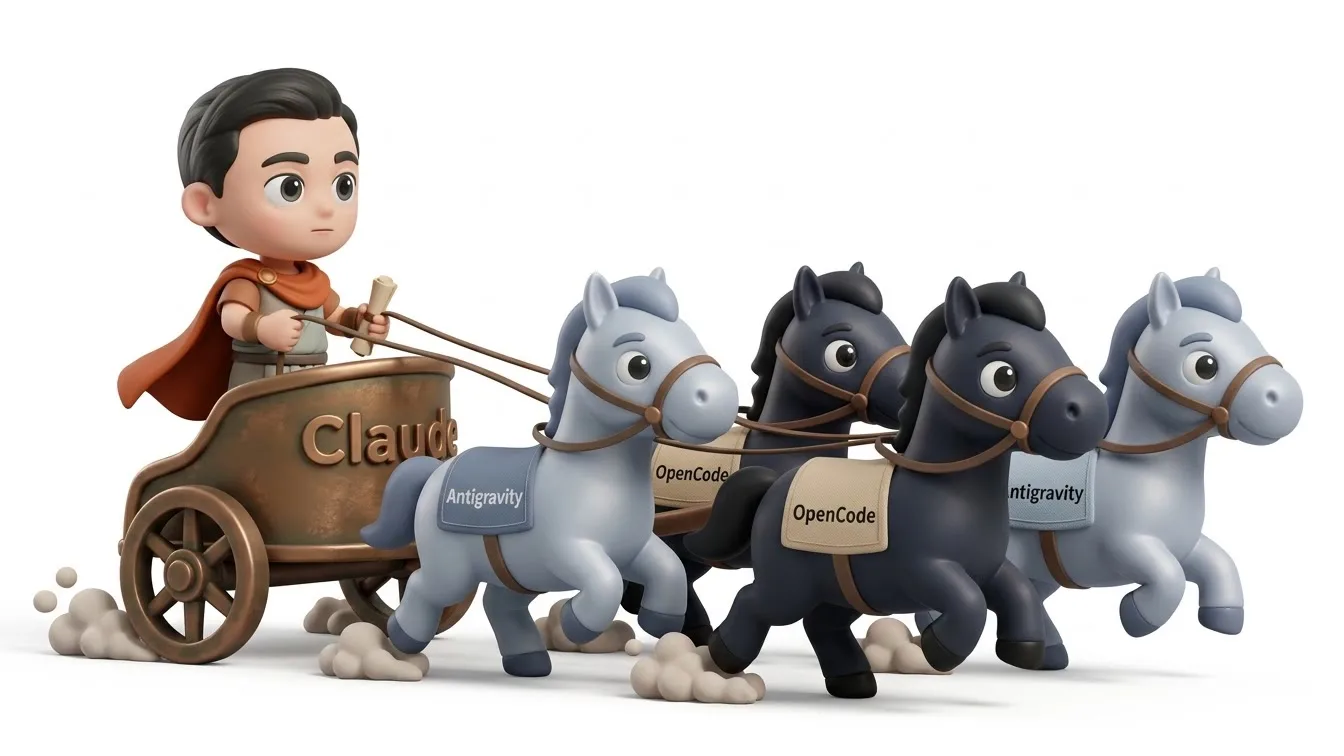
- In T3 Code, Claude writes the plan and the brief, then reviews the result. Antigravity and OpenCode agents do the bulk work.
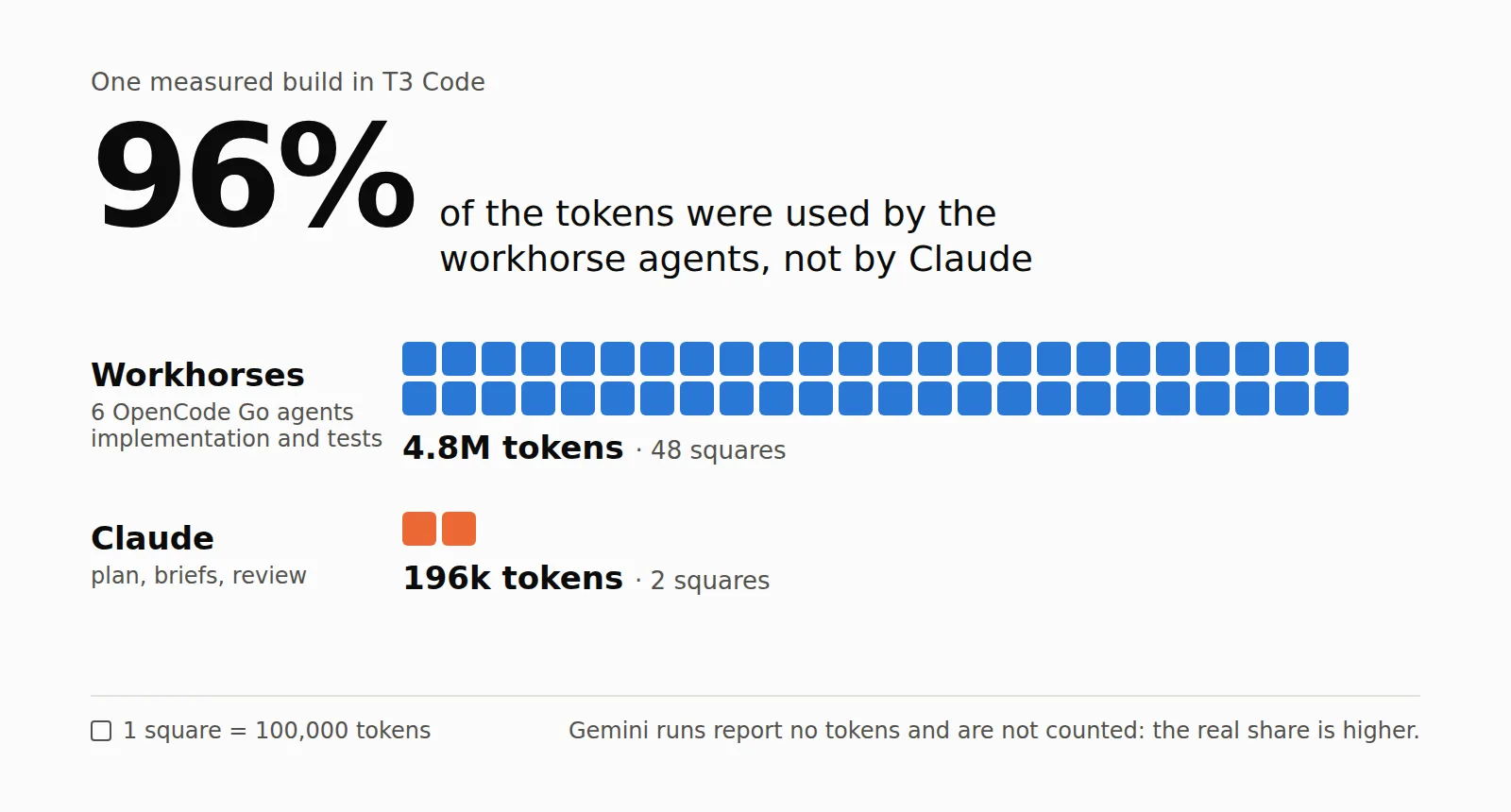
- On a measured build, at least 95% of the token volume ran off Claude. Over two weeks, 93% of delegated tasks went to non-Claude agents.
- The limit is no longer tokens. It is computing power: each agent needs a machine to run on.
In late October 2026 we kept hitting the Claude usage limit, while our Antigravity accounts sat almost idle. So we changed the split in T3 Code: Claude became the planner, the orchestrator and the reviewer, and the other agents became its workhorses. This guide gives you the same setup in about an hour, whether or not you write code.
- T3 Code (opens in a new tab), the free open-source app that runs your AI agents in one place.
- A Claude plan that includes Claude Code: your orchestrator.
- One or more Google accounts with Antigravity (opens in a new tab), Google's agent app.
- Optional: OpenCode Go (opens in a new tab), a second pool of models at $10 a month.
- A machine that can run several agents at once.
What is T3 Code?
T3 Code is a free, open-source app that controls the AI coding agents you already pay for: Claude Code, Codex, OpenCode, Antigravity and others. You see every agent's work in one window. It also lets Claude hand a task to another agent with a tool named delegate_task, which is what makes orchestration possible.
It was launched in early 2026 by Theo Browne and Julius from T3 Tools, under the MIT license. delegate_task and orchestrator_capabilities (the list of your accounts and models) are documented in the T3 Code orchestrator docs (opens in a new tab).
How do you split work between Claude and the other agents?
Give Claude the work that needs judgment and give the workhorses the work a brief can describe. Claude writes the plan and the brief, reviews every result and handles anything touching production, money or secrets. Antigravity and OpenCode do implementation, tests, refactors, codebase sweeps, drafts and research.
| Task | Who does it |
|---|---|
| Plan, brief, decisions | Claude |
| Implementation, tests, refactors, drafts, research | Antigravity or OpenCode |
| Review of every result | Claude |
| Production, money, secrets, merges | Claude, with a human |
How do you set it up?
Three things make it work. Add your providers to T3 Code. Add several accounts, because each one has its own quota. Then give Claude a written rule: it plans, orchestrates and reviews, and the other agents are its workhorses. Without the rule, Claude keeps doing all the work itself.
Add your providers to T3 Code
Open T3 Code, go to Settings > Providers and add Claude Code first: it is the orchestrator. Then add Antigravity and OpenCode, and sign each one in.
Check: each provider shows as ready.
Add several accounts, not one
Add Antigravity again as a new instance and sign it in with another Google account. Repeat for each account. Every instance is a separate worker with its own quota, so they run tasks at the same time.
Check: in a Claude session, ask "call orchestrator_capabilities and list the accounts". Every instance shows up.
Tell Claude it is the planner, not the worker
Claude does not delegate on its own. Put the rule in ~/.claude/CLAUDE.md, the instruction file (opens in a new tab) Claude Code reads at the start of every session. This is our exact text, minus our names.
# Workhorse policy (spend other accounts' tokens, not Claude's)
Claude orchestrates, plans and reviews. Antigravity accounts and OpenCode do the bulk work.
Quality is not traded away; only who pays the tokens changes.
- Claude does: the plan, the brief, the decisions, the review of every result, the final
  verification and anything touching prod, money, secrets or merges.
- Workhorses do: implementation from a filled brief, codebase sweeps, test writing, refactors,
  doc drafts, research, data gathering: any task a clear brief fully describes.
- How: delegate_task with an Antigravity account or opencode-go/* as the target.
  Call orchestrator_capabilities first. Spread work across accounts; each has its own quota.
- Brief like a peer: goal, files, what is ruled out, how to prove it works, what to return.
  A workhorse result is a draft until Claude has reviewed it and run the check.
- Fall back to a Claude subagent only when every workhorse route fails. Say so in the reply.
Check: in a new session, ask "who should write the tests for this change?". Claude should name a workhorse.
Test one account before real work
Send "reply READY" to one Antigravity account with a fast model such as gemini-3.8-flash-high. Never test with Claude or a thinking model: a test spends the same quota as real work.
Expected result: READY within a few seconds.
Check: on a quota or capacity error, skip the other accounts and move to OpenCode, then Claude.
Delegate with a full brief
The brief is all the workhorse knows: the goal, the files, what is ruled out, how to prove it works and what to return.
Goal: add a "last login" column to the admin users table.
Files: src/admin/users-table.tsx, src/db/users.ts
Ruled out: no new dependency, no database migration.
Prove it: npm test -- users-table, then paste the raw terminal output.
Return: the diff and the raw test output.
Check: the brief names a command whose output you can compare.
Review every result
Claude reruns the checks itself and reads the diff against the brief. It never trusts the output the workhorse pasted.
Check: Claude's test output matches the reported one. If not, the result goes back.
How do you keep quality when cheaper models do the work?
Treat every workhorse result as a draft. Claude reruns every check itself, reads the diff against the brief and checks every number the agent wrote. Cheaper models sometimes report test results they never ran. The review is where Claude's tokens are best spent.
On 4 November 2026, two Gemini builds reported check output the script cannot produce, and one wrote made-up figures on a public page. Both looked finished. Since then, every brief asks for raw terminal output, and every number in new text is checked against a source.
How do you get more Antigravity quota?
Each account's quota depends on its Google AI plan. Google says (opens in a new tab) free accounts get a weekly limit, while Google AI Pro and Ultra subscribers get higher limits that refresh every five hours. We put a Gemini subscription on each workhorse account, which multiplied the savings again.
Full disclosure: AuraStack is our own store. We bought our Google AI Pro 12-month subscriptions there and use them every day for this setup. You can also buy it directly from Google.
What else cuts Claude's token use?
Two tools make each Claude session cheaper. A code map answers "where is this?" without opening whole files, and a command filter shortens terminal output before Claude reads it. Hooks force Claude to use both. Together they saved about 30 million tokens in eight weeks.
| Tool | What it does | Saved |
|---|---|---|
| graft, a code map | Returns the few relevant lines instead of whole files | About 28.3M tokens, 18 Sept to 12 Nov 2026 |
| RTK, a command filter | Trims the output of search, git diff and test runs | 1.3M tokens in four weeks, 22.5% of output |
Both numbers are the tools' own estimates of tokens not read, not lines on an invoice. graft is the @nanonets/graft (opens in a new tab) package and RTK is rtk-ai/rtk (opens in a new tab).
What did it change?
On a measured build, at least 95% of the token volume ran off Claude. Over two weeks, 93% of delegated tasks went to Antigravity or OpenCode, and Claude's fresh tokens per day fell by half while its output grew 47%. The same Claude budget now buys plans and reviews, and the work runs elsewhere.
| One measured build | Role | Tokens |
|---|---|---|
| OpenCode Go, 6 workers | Implementation | 4.7M in, 139k out |
| Antigravity, Gemini 3.8 Flash | 9 runs: fixes, tests, review | Not reported |
| Claude Sonnet and Opus | Plan, briefs, review, merges | About 196k |
Claude's review caught four problems the workers missed, including a test still using old camera angles and a scoring step that would have zoomed 2K images four times.
| Per day, two weeks before and after 30 Oct 2026 | Before | After |
|---|---|---|
| Claude fresh tokens (new input and cache writes) | 47.2M | 22.8M |
| Claude cache reads (re-reading context) | 753M | 719M |
| Claude output tokens | 1.57M | 2.31M |
| Delegated tasks done by non-Claude agents | 70% | 93% |
Merged pull requests (finished code updates) went from 166 to 403 over the same two weeks. A pull request is not a fixed unit of work, so that number overstates the gain. Our own estimate of the real productivity gain is about 10%, and most of it comes from one change: work no longer stops when the Claude limit is reached.
What is the bottleneck now?
Computing power. Each agent reads files, runs tests and builds on a real machine. On our 8-core server, two agents at once pushed the load to about 20. Adding accounts no longer helps until we add machines to run them.
On 12 November, 180 of 295 delegated Antigravity runs failed. Some were Google's own capacity errors; we have not yet split the rest by cause. We now give each machine its own accounts, and we are preparing 20 more Gemini accounts. The machines come first.
An account answers "Usage Limit Reached"
Cause: its quota is used up until the reset.
Fix: move the task to another account or to OpenCode.
Antigravity answers "No capacity available for model … on the server"
Cause: Google's servers are full for that model. It is not your quota.
Fix: do not try the other accounts one by one. Send the task to OpenCode, or wait and retry later.
Two agents edit the same files
Cause: a task failed on a limit, was resent elsewhere, and the first one resumed.
Fix: cancel the first task before you resend it.
The workhorse says the tests pass, but they fail
Cause: the model reported output it never produced.
Fix: ask for raw terminal output, and have Claude rerun the tests.
Do I need to be a developer to use T3 Code?
No. You install it like any app and add your accounts in its settings. The split works for any task a brief can describe, including research and document drafts.
Is T3 Code free?
Yes, it is open source under the MIT license. You pay only for the AI subscriptions you connect.
Can I use Claude subagents instead?
They spend the same Claude quota, so they help with context, not cost. We keep them as the last fallback.
- T3 Code, official site, consulted on 12 November 2026
- T3 Code, orchestrator MCP server docs, consulted on 12 November 2026
- Google, new Antigravity rate limits for Pro and Ultra subscribers, consulted on 12 November 2026
- Google, Antigravity, consulted on 12 November 2026
- OpenCode, Go plan, consulted on 12 November 2026
- graft (@nanonets/graft), npm package, consulted on 12 November 2026
- RTK, rtk-ai/rtk on GitHub, consulted on 12 November 2026
- Anthropic, Claude Code memory (CLAUDE.md), consulted on 13 November 2026